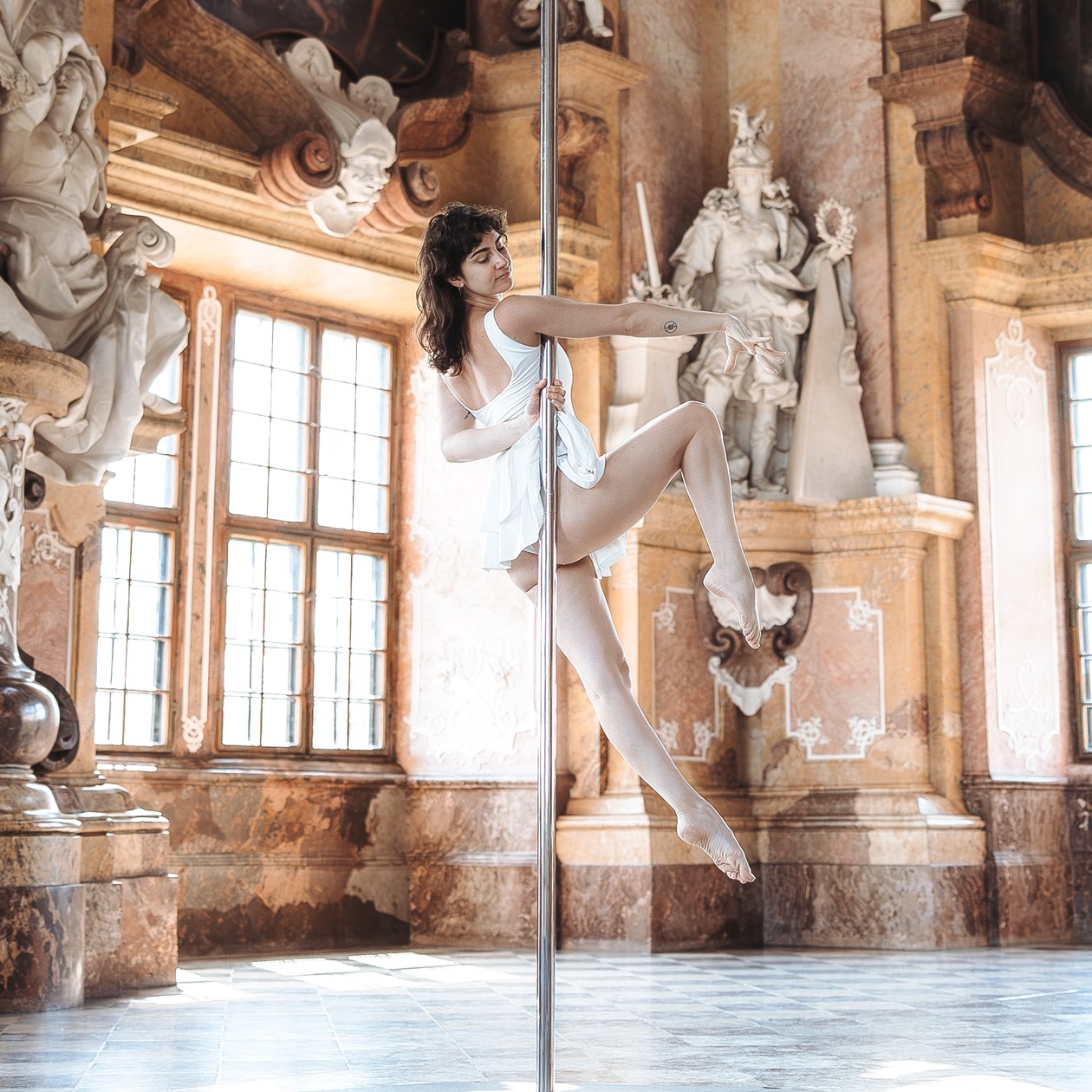
Pole dance is dance and acrobatics on a vertical pole. It mixes strength, gymnastics and moving to music: in class you learn spins, shapes and transitions, and then you link them into combos. I've been training since 2016 and I teach pole dance myself, so let me show you what it really looks like from the inside.
What is pole dance, exactly?
The pole is your training equipment. You spin around it, climb it, hold shapes on it, and later on you go upside down. On top of that comes the dance part: smooth transitions, floor and leg work, and music. That's why some people call pole dance a sport and others call it a dance. Honestly? It's both.
Pole dance at a glance
| Question | Short answer |
|---|
| What is it? | Dance and acrobatics on a vertical pole |
| Dance or sport? | Both: there are federations and competitions, but also choreography and pole art |
| What styles are there? | Pole sport, pole art, exotic pole (in heels) and pole fitness |
| What kind of pole? | A static pole or a spinning one |
| What to wear to your first class? | Shorts or mid-thigh leggings and a T-shirt; you train barefoot |
| Who is it for? | Anyone who wants to try; you build strength along the way |
Where does pole dance come from?
Training on a vertical pole is much older than the pole dance you know from the studio. In India, people have practiced mallakhamb, acrobatics on a wooden pole, for centuries, and Chinese pole is a circus classic.
Pole dance itself took a different route. In the 1920s, dancers in traveling shows in the US danced around tent poles. Later the pole moved into clubs, and from the 1980s dancers in Canada and the US started adding climbs, spins and inversions. In the 1990s a Canadian dancer, Fawnia Mondey, started teaching pole dance classes. Studios, competitions and federations followed (you can read the history on Wikipedia).
Pole dance partly comes from club dancing, and there's nothing wrong with that – it's simply how it was born. Over the years, though, it has grown into many forms: sporty, artistic and dance-based, in heels and barefoot. Today people come to class because they want to move, feel strong and have fun.
Is pole dance a sport?
Yes. Pole dance has its own international federation, the IPSF (International Pole Sports Federation), which has written judging rules and runs world championships. In 2017 the federation was granted observer status by GAISF, the global association of international sports federations at the time, which was dissolved in 2023 (sources: pole sports, GAISF). I write more about why it isn't “just a club thing” in Pole Dance for Everyone.
And the Olympics? Pole dance isn't part of the Olympic program. The IPSF openly works towards getting it there one day (IPSF about us), but for now that's a goal, not a fact.
What does a first pole dance class look like?
A video says it best. On my channel you can watch the very first pole class of my friend Alicja Janosz, a singer and the winner of the first season of Idol in Poland. Alicja has done yoga for years, so she's no stranger to movement, but she had never been on a pole before.
The video is in Polish. Watch it on YouTube: “Uczę Alicję Janosz – jej pierwsza lekcja pole dance”.
Here's roughly how a first lesson goes:
- Take off your jewelry. Wedding ring and everything else, so you don't hurt yourself or the pole.
- Warm up. That's usually how training starts (we skipped the warm-up in the video).
- Get to know the pole. You hold it, walk around it and learn your first transitions close to the floor.
- Do your first spin. Usually it's the Fireman, the most basic spin and the one everyone learns in their first class. I show the position on the floor first, and only then do we try it on the pole.
- Link the moves. Two or three simple elements become your first short combo.
One thing you'll notice in the video straight away: you can't do anything on the pole with a floppy body. Your shoulders go down, your shoulder blades engage, your abs and glutes work. That's why pole dance trains your whole body, and that's also why you don't need strong arms to start. You build the strength as you go.
To be honest with you: at the beginning you may get bruises and scrapes, and your hands can hurt. That's normal.
Static or spinning pole – what's the difference?
A static pole stays still, so you drive yourself into each spin. A spinning pole turns with you, so you have to work harder to hold the position.
What should you bring to your first pole dance class?
- Clothes you feel good in. Shorts or mid-thigh leggings and a T-shirt are plenty for a first class. Bare legs help from day one: in the Fireman you hold the pole with your knees, and skin grips better than fabric. I point this out to Alicja in the video. Later, for harder shapes, you'll want more bare skin. That's when pole dance clothing comes in handy.
- Bare feet. You train on the pole barefoot. Platform heels belong to a separate style, exotic pole, and you won't need them for your first class.
- Water and a small towel. Useful after the warm-up and for wiping your hands.
If your hands get sweaty and you slide down the pole, chalk or a grip aid will help later on.
Who is pole dance for?
For anyone who wants to try it. You don't need to be strong, flexible or a “natural dancer”, because that's exactly what you learn in class. Women and men both train on the pole. Pole dance builds strength, especially in your core, plus body awareness and confidence.
If you're scared of being judged, you're not alone. In my chat with Klaudia, a fellow instructor, we talked about a girl who took seven years to come to her first class because she felt embarrassed. You can watch the whole conversation (in Polish) here: “Pole dance bez filtra: hejt, kontuzje i nasze poldensowe ery”.
How do you start pole dancing?
- Find a studio and an instructor you feel safe with.
- Sign up for a beginner class and give yourself a few weeks before you decide whether it's for you.
- Keep track of what you've learned. At first the shape names all blur together. I've put names and levels together in my pole dance shapes catalog.
For exactly that, I created the Pole Shapes Book Beginner, because I needed it myself in the studio. It's a binder with 70 beginner shapes, each with a description of the grip and the entry. Under every shape there are three circles – almost · done · perfect – so you can see how you're growing. The cards are resistant to chalk, so you can take them right onto your mat. See if it's something for you.
Pole dance FAQ
What does “pole dance” mean?
It's dance and acrobatics on a vertical pole. In Polish it's called “taniec na rurze”, and in Polish studios people simply say “poldens”.
Is pole dance the same as stripping?
No. Pole dance partly grew out of club dancing, but today it's first of all strength and technique training: studio classes, competitions, pole art, and exotic pole as a dance style of its own.
Is pole dance hard for beginners?
You learn your first spin, the Fireman, in your very first class. Harder shapes come with time, as you get stronger. Bruises at the beginning are normal.
Is pole dance an Olympic sport?
No. The international federation, the IPSF, is working to get pole dance into the Olympic program one day, but it isn't an Olympic sport today.
What are the benefits of pole dance?
It builds strength, especially in your abs and your whole core, along with body awareness and confidence.
And if you're still unsure, go to one class and see how you feel on the pole. What matters is that you started. 🩷